Hope Crosby
SCOTTISH ROMANCE: My Sinful Surrender to a Highlander Werewolf (Scottish Werewolf Pregnancy Romance) (Historical Medieval Shape Shifter Paranormal Science Fiction Short Stories)Hope Crosby’s defining arc begins in bereavement and financial danger but develops into a story of chosen family. At twenty-two, she is widowed after five years of marriage, carrying both the memory of Hank and a child who is not Avery’s. Her decision to become a mail-order bride is initially practical rather than romantic: it is a desperate attempt to protect what remains of her life. Avery’s acceptance of her pregnancy transforms that arrangement into an emotional commitment and gives Hope a future she had not believed possible.
Identity and Background
Hope is presented as a young woman whose identity has been abruptly destabilized by loss. She had believed that marriage to Hank completed her life, and she regarded him as the man she was meant to be with. His death from a rare, apparently noncontagious disease therefore removes not only her husband but also the security and future she had built around him. She remembers waking in the night expecting to find him beside her, only to encounter the empty side of the bed, making grief an ongoing physical presence rather than a concluded episode.
Hope’s widowhood is compounded by material vulnerability. Hank has left debts behind, and the bank is prepared to foreclose on the property within a day. She secures only a temporary extension, relying on emotional appeals to persuade the bank to delay action. Her family loyalty is equally strong: she describes her family as central to her life and insists that she would risk herself to protect her husband and everything he worked for. The combination of grief, debt, and responsibility leaves her with little room for a conventional recovery.
The narrative also emphasizes Hope’s self-conscious awareness of her appearance and social value. She describes her long blond hair, hourglass figure, and physical strength as qualities her mother taught her not to take lightly. Yet the story places those qualities beside her fear of becoming economically exposed again, showing that desirability does not protect her from widowhood, debt, or public judgment.
The Mail-Order Decision
Hope discovers the possibility of a new life in a periodical accidentally brought home with her groceries. The advertisement offers her a route away from foreclosure: she can become a mail-order bride, find a man willing to help preserve her property, and perhaps secure a practical future even if love does not follow. She does not pretend that the plan guarantees romance. Instead, she treats it as a possible silver lining in circumstances that have reduced marriage to a question of survival.
Her journey takes place in the Old West of 1855, where she recognizes that a mail-order bride is likely to be scorned. She knows the town will regard such women as desperate and believes that respectable religious communities will not easily understand the choice. The stagecoach ride therefore carries more than physical movement. Hope leaves behind the life she shared with Hank while entering a public space where her need can become a source of shame.
Avery’s advertisement attracts her because it promises more than wealth. He presents himself as a Christian man who will treat a woman with respect and kindness, asks only for help with daily chores, and openly identifies himself as the owner of a ranch with two hundred acres. Hope is drawn to the apparent honesty and eloquence of the notice. Their correspondence also reveals parallels: both are only children, and both have fathers who died young and left their mothers to raise them. Hope interprets these similarities as evidence of a kindred spirit before they meet.
Meeting Avery and the Pregnancy Disclosure
When Hope arrives, Avery meets her with daisies, her favorite flowers, and treats her with the courtesy promised in his advertisement. The watching townspeople intensify her awareness that she is entering a socially exposed arrangement, but Avery’s conduct gives the encounter a more personal character. He opens the stagecoach door, offers his hand, and presents the ranch as her new home. Hope sees in him a rough, handsome man whose physical presence is matched by the possibility of safety.
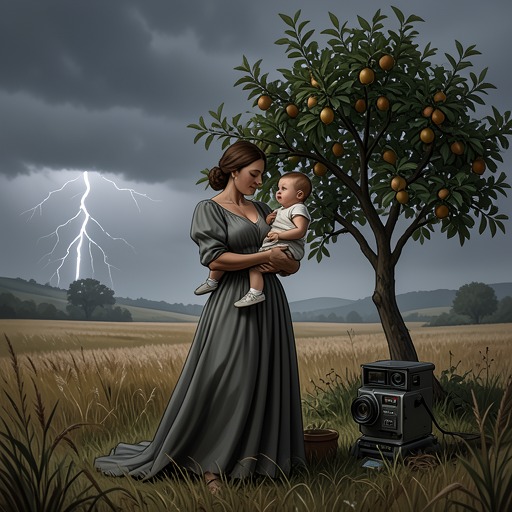
The marriage ceremony quickly becomes a test of whether that safety is real. After the church service, another woman congratulates Hope and places a hand on her stomach, recognizing the pregnancy before Hope has told Avery. Hope is horrified by the public disclosure and runs from the church to a tree beside a pond. Her flight expresses both shame and fear: the practical arrangement may collapse once Avery learns that the child belongs to Hank.
Avery follows her and refuses to treat the pregnancy as a reason to abandon her. He tells her that the revelation changes some circumstances but not his love, and that he will be honored to become part of her family. He admits that he was shocked, yet his shock leads him to recognize that he does not want to live without Hope. His acceptance is not presented as indifference; it is a conscious decision to accept both Hope and Hank’s child.
Hope’s response marks the emotional reversal of her story. She begins the encounter expecting rejection and ends it in tears of joy, resting against Avery’s chest and hearing his heartbeat. She asks him not to offer comfort merely to make her happy, because she understands that many men would reject a child who was not biologically theirs. Avery’s willingness to accept the baby makes her fall in love with him more deeply, turning a marriage begun under financial pressure into a relationship grounded in compassion and commitment.
Relationships and Conflict
Hope’s relationship with Hank remains central even after his death. She does not erase him or treat the pregnancy as an inconvenience to be concealed permanently. The child is Hank’s, and Hope’s grief continues to shape how she understands marriage, motherhood, and the future. Her connection to Avery is therefore not a simple replacement of one husband by another; it is an attempt to carry an existing family bond into a new household.
Avery becomes significant because he rejects the possessive logic that could have made the pregnancy a betrayal. His response grants Hope dignity at the moment when she expects to lose it. He accepts that she arrives with a history, a dead husband’s child, and obligations that cannot be separated from her identity. The relationship consequently shifts from an exchange designed to save property into a shared family arrangement.
Hope’s conflict with the surrounding community is quieter but persistent. The town watches her arrival, and she anticipates condemnation from people who regard mail-order marriage as evidence of desperation. Her fear of judgment follows her into the church, where the accidental pregnancy announcement exposes the private vulnerability she had hoped to manage herself. Avery’s response counters that public suspicion with private loyalty.
Change and Narrative Significance
Hope changes from a woman trying to prevent foreclosure into a woman capable of accepting love without denying grief. At the beginning, her options are defined by Hank’s debts, the empty bed, and the imminent loss of her home. The mail-order advertisement offers a calculated escape. By the end of the disclosed arc, Avery’s acceptance gives the arrangement emotional depth, and Hope can imagine belonging somewhere again.
Her story reflects a recurring tension in the book between intimate feeling and economic necessity. Marriage is initially a survival strategy: Hope needs a husband who can help preserve her household, just as other characters consider marriage, citizenship, inheritance, employment, or reproduction through contractual terms. Yet Hope’s experience complicates that transactional framework. The advertisement brings her to Avery, but his response to her pregnancy creates the possibility of love beyond the original bargain.
Hope’s decisive narrative function is to make acceptance the turning point rather than the reward for concealment. She does not become secure by hiding her past; she becomes secure when Avery learns the truth and chooses to remain. Her pregnancy, widowhood, debt, and public embarrassment are not obstacles that disappear. They become the exact circumstances through which Avery proves that the new family he offers includes the life Hope already carries with her.